Most teams debate Agile vs Waterfall testing as if one is objectively better. In reality, both work – and both fail – depending on the type of project you’re running. The real risk isn’t choosing the wrong methodology. It’s not understanding what each one was built for.
This piece breaks down the difference between Agile testing methodology vs the Waterfall testing model clearly – what each approach looks like in practice, when to use one over the other, and how to make the right call for your project.
Table of Contents
The One-Line Version of Each
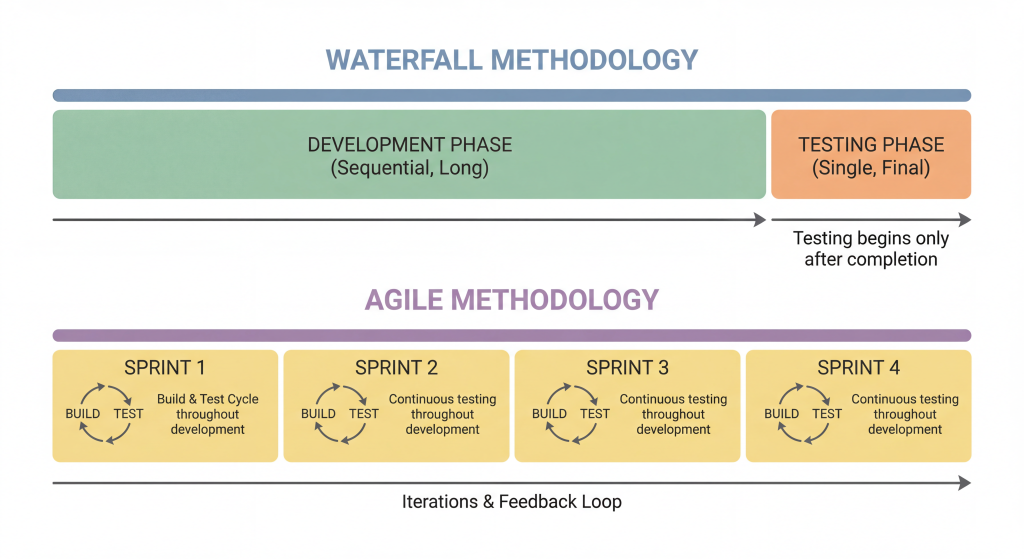
Waterfall Testing is a sequential, phase-based approach where testing begins only after the entire product has been built. Think of it as asking: “Does this completed product match what we agreed to build six months ago?”
Agile Testing is a continuous, embedded practice where testing runs in parallel with development throughout every sprint. It’s asking: “Does this working slice of the product do what we need – right now, this week?”
Both sound clear in isolation. The confusion kicks in when teams try to apply them to projects they weren’t designed for. So let’s go deeper.
Where These Approaches Actually Came From
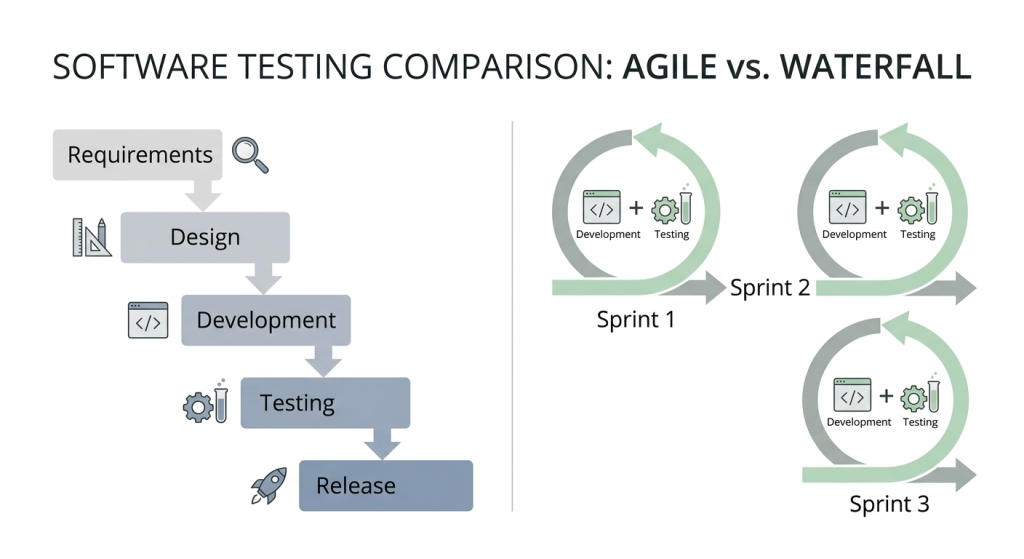
Waterfall was first formally described by Winston W. Royce in 1970. It follows a strict sequential model – Requirements → Design → Implementation → Verification → Maintenance. Each phase produces a documented output that becomes the input for the next.
No phase begins until the previous one is signed off. It was designed for large-scale software systems where requirements could be fully defined upfront, and changes mid-cycle were considered failures of planning.
Agile was formalized in 2001 through the Agile Manifesto, written by seventeen software engineers who had spent years watching Waterfall-driven projects fail – not because the code was bad, but because the process couldn’t respond to change.
Agile introduced short development cycles called sprints, continuous feedback loops, and testing embedded directly into the development workflow. Instead of delivering one large release at the end, Agile teams ship working software incrementally throughout the project.
Waterfall testing asks whether the finished product matches the original specification. Agile testing asks whether the current build serves the user’s actual needs – today.
How Each Model Actually Flows
Waterfall Testing Model          Agile Testing Methodology

Requirements                     Sprint 1 → Build + Test
     ↓                           Sprint 2 → Build + Test
Design                           Sprint 3 → Build + Test
     ↓                           Sprint 4 → Build + Test
Development                              ↓
     ↓                               Release
Testing
     ↓
Release
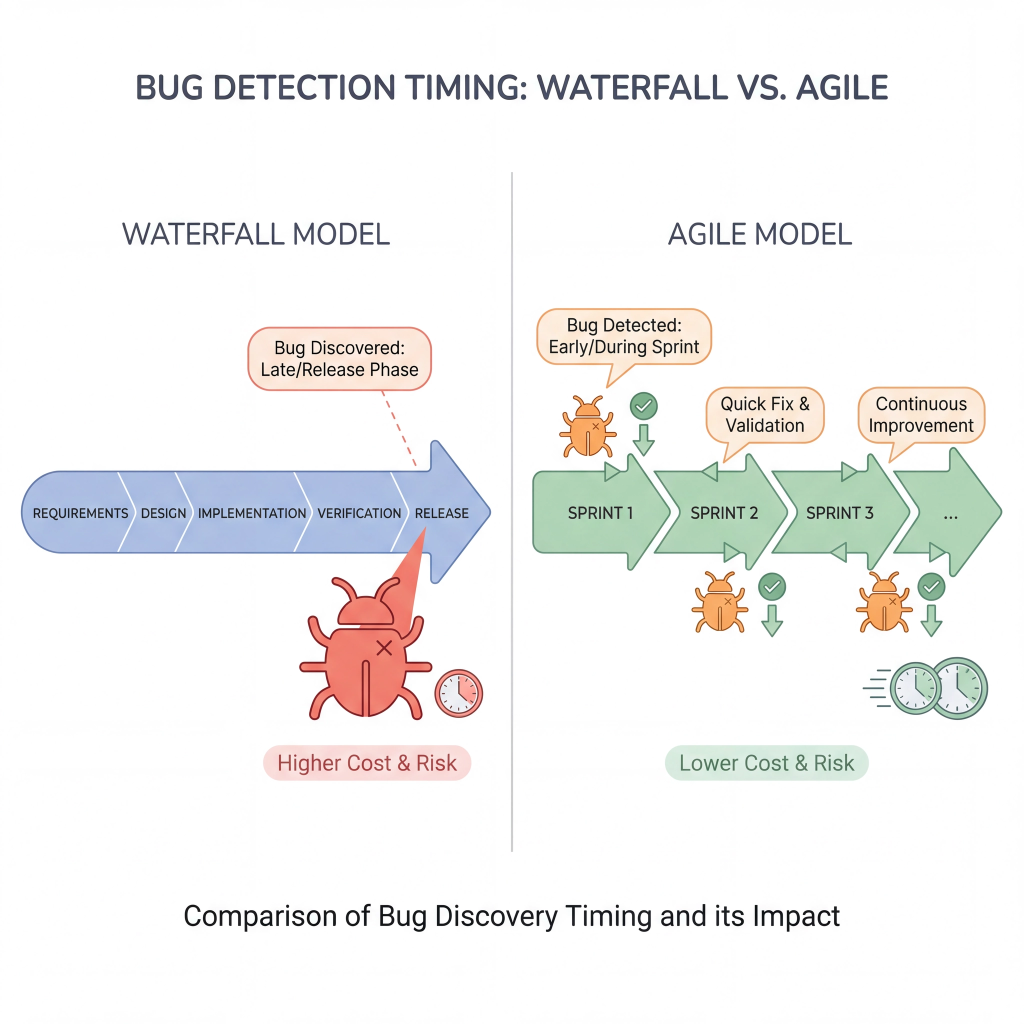
In Waterfall, testing is a single phase at the end. In Agile QA, testing runs inside every sprint – which means defects are caught weeks or months earlier.
Agile vs Waterfall Testing: Breaking Down the Practical Differences
Definitions are easy to memorize and just as easy to misapply. What actually separates these two in day-to-day QA work is when testing starts, how the team is structured, what documentation looks like, and what failure actually costs you.
What Triggers Testing
The completion of the development phase triggers waterfall testing. There’s a formal handoff moment – developers declare the product built, and it passes to a dedicated QA team. That team then works through a predefined test plan against the full application. Testing is a distinct, bounded event with a start and end date on the project timeline.
Agile testing has no single trigger. It starts on day one and runs continuously. As soon as a feature is developed – even partially – it enters testing. Testers and developers work in the same sprint, often on the same stories. There’s no handoff moment because there’s never a point where development stops, and testing begins.
Real-world example:
A team is building a SaaS project management tool. Under Waterfall, the entire platform – user authentication, workspace setup, task management, reporting dashboard, and notification system – gets developed over five months, then handed to QA for a full test cycle.
A bug in the authentication module discovered in week three of testing means reworking code that was written four months ago. Under Agile, authentication is built and tested in sprint one, task management in sprint two, and so on.
Each module is verified before the next is built on top of it. By the time the full platform exists, every core feature has already been tested, iterated on, and stabilised.
Scope – Sequential vs. Continuous
Waterfall testing is comprehensive but late. By the time testing begins, the entire application is available – every feature, every integration, every edge case.
The problem is that bugs found at this stage are expensive: the developer who wrote the code finished it months ago, context is cold, and fixing one thing risks breaking others in a fully integrated system.
Agile testing is incremental and early. Each sprint delivers a small, testable slice of the product. Defects are found while the code is fresh, the developer is still nearby, and fixes take hours instead of weeks.
The difference between Agile and Waterfall QA is essentially the difference between catching a bug on day five versus catching it on day ninety.
3. Documentation and Formality
Waterfall testing is built on heavy, upfront documentation. Before a line of code is written, the QA team produces a master test plan, detailed test cases for every requirement, traceability matrices linking tests back to specifications, and formal defect reports.
This documentation is a deliverable in its own right – it proves what was tested, how, and to what standard. In regulated industries, this isn’t optional.
Agile testing operates on lightweight, living documentation. Test cases exist, but they’re often written in plain language as acceptance criteria on user stories.
Documentation is updated as requirements evolve rather than locked in at the start. The emphasis shifts from proving what was planned to demonstrating what works. This is faster, but it requires discipline – undocumented decisions accumulate fast on larger teams.
Waterfall vs Agile Testing Comparison at a Glance
| Aspect | Waterfall Testing | Agile Testing |
|---|---|---|
| When it starts | After full development is complete | Sprint one, day one |
| Team structure | Siloed – separate dev and QA teams | Cross-functional – testers embedded in squads |
| Documentation | Formal, extensive, upfront | Lightweight, iterative, just-in-time |
| Requirement changes | Expensive and disruptive | Accommodated naturally |
| Defect detection timing | Late – post-development | Early – within each sprint |
| Cost of fixing bugs | High – cold context, integrated system | Low – fresh code, isolated feature |
| Best for | Fixed, well-defined, regulated projects | Dynamic, evolving, fast-moving products |
| Test planning | Complete plan before work begins | Plan evolves sprint by sprint |
| Core question | “Does the fully built product meet every requirement we documented at the start?” | Complete the plan before work begins |
What Happens When It Fails
A testing failure in Waterfall means a formal defect cycle at the worst possible time. Bugs are logged, prioritized, assigned back to development, fixed, and then re-tested – all within the testing phase, which has a hard end date tied to the release date.
The later in the testing phase a defect is found, the more pressure it creates. Major defects discovered in the final week of a six-week testing cycle have delayed or derailed entire product launches.
A testing failure in Agile means a sprint-level fix before the next increment begins. The defect is caught within the same sprint or the next one at the latest.
The developer is still working on that part of the codebase. The fix happens quickly, gets retested, and the team moves forward. There’s no accumulated technical debt waiting at the end of the cycle to ambush the release date.
Waterfall failure example:
An e-commerce platform’s Waterfall test cycle reaches week five. A critical defect surfaces – the checkout flow silently drops items from the cart for users with more than ten products. This touches three separate modules that were written by two different developers four months ago.
Understanding, fixing, and verifying the fix takes two weeks. The release date slips. Everyone knew the pressure was building; no one saw the exact shape it would take.
Agile failure example: In sprint three of the same project, a tester checks the cart flow as it’s being built. A developer hardcoded a maximum product count of ten during development.
The bug is caught that afternoon, flagged in the sprint board, and fixed by the end of the day. The developer who wrote it is three desks away. The sprint ships on time. The defect never reaches the integration layer.
When to Use Waterfall vs Agile Testing
Getting this decision right comes down to a single question you need to answer honestly: how well do you understand your requirements today, and how likely are they to change?
If your requirements are fixed and fully defined – a regulatory compliance system, a government contract, embedded software for a hardware device – Waterfall testing gives you the structured, documented assurance that every specified requirement has been verified. The upfront investment in planning pays off because nothing is changing underneath you.
If your requirements are likely to evolve – a consumer app where user research might shift priorities, a SaaS product responding to market feedback, or any project where the business strategy is still developing – Agile testing lets the product change course without a testing process that fights it at every step.
When in doubt: known, stable requirements → Waterfall. Evolving, user-driven requirements → Agile.
Check out the best Laravel template – Sneat.

Common Mistakes Teams Make With Each Approach
Even experienced QA teams fall into these patterns. Recognizing them is the first step to avoiding them.
Applying Agile to a project that needed the waterfall structure.
- Some projects – like healthcare, finance, or government software – have strict compliance rules. They need formal test records, sign-offs, and full traceability. Agile’s flexible, lightweight approach doesn’t produce that level of documentation, which creates real audit and legal risk.
Applying the waterfall to a project that needed Agile’s flexibility.
- If your product requirements are likely to change based on user feedback or market shifts, locking them in at the start of the project is a mistake. By the time you finish building and testing, what you’ve built may no longer match what users actually need.
Treating Agile testing as “no planning.”
- Agile doesn’t mean undisciplined. It means planning in shorter cycles. Teams that interpret Agile as permission to skip test strategy, skip documentation, and skip structure end up with unpredictable quality and untraceable defects.
Delaying testing to the end of the waterfall out of habit.
- Even within a Waterfall project, nothing prevents testers from reviewing requirements, creating test cases, and flagging ambiguities during the design phase. Many of the worst late-stage defects could have been caught as requirement errors weeks earlier.
Skipping regression testing in Agile sprints.
- Because each sprint focuses on new features, teams sometimes forget that the last sprint’s features still need to work. Without ongoing regression coverage, Agile projects can quietly accumulate breakage across features that haven’t been touched in weeks.
A Practical Checklist for Each
What structured Waterfall testing should include:
- Complete test plan written against the formal requirements document
- Traceability matrix linking every test case to a specific requirement
- Test environment that mirrors the production system
- Full regression pass across the entire application
- Formal defect logging with severity, priority, and status tracking
- Sign-off documentation from QA, development, and stakeholders
- Regression retest after all defect fixes are complete
- Final release readiness report with pass/fail metrics
What effective Agile testing should include:
- Acceptance criteria are defined on every user story before the sprint begins
- Testers involved in sprint planning and story refinement
- Test cases written alongside development, not after
- Definition of Done that includes testing as a requirement, not an afterthought
- Regression checks on previously completed features each sprint
- Exploratory testing sessions for new features before the sprint review
- Automated smoke suite covering core user flows – runs on every build
- Retrospective review of testing coverage and defect escape rate
When One Bleeds Into the Other
Here’s a nuance most comparisons skip: in practice, especially on mid-sized teams, the boundary between Agile and Waterfall testing often blurs – and that’s not necessarily a bad thing.
Many teams run what’s effectively a hybrid model: high-level project milestones follow a Waterfall structure (defined phases, fixed deliverables, formal sign-offs), while development and testing within each phase operate in Agile sprints. The outer structure gives stakeholders predictability. The inner structure gives the team flexibility.
This is common in enterprise environments where procurement, compliance, and vendor contracts require Waterfall-style planning, but engineering teams have adopted Agile practices. Neither camp wins outright – the project uses both, deliberately.
The key is intentionality. If your question is “Does the completed system match the contracted specification?”, you’re working in Waterfall territory. If your question is “Does this increment do what users actually need?”, you’re working in Agile territory. Let the question define the approach, not the other way around.
The Automation Question
Waterfall testing has clear automation candidates – regression suites, smoke checks, and performance tests that run against the completed build.
Because the test plan is defined upfront, automation scripts can be written in parallel with development and run as soon as testing begins. The challenge is that automation in Waterfall often arrives too late: scripts written for a complete system can’t catch defects during development.
Agile testing depends on automation to stay sustainable. Running a manual regression pass on every sprint across a growing application is a losing battle. Teams that automate their core regression suite early – using tools like Selenium, Playwright, or Cypress – free their testers to focus on exploratory work where human judgment adds value. In a CI/CD pipeline, automated tests gate every build: if the suite fails, the code doesn’t proceed.
Automate what repeats every sprint. Apply judgment where context and user behaviour can’t be scripted. Waterfall rewards thorough automation at the end. Agile requires it from the beginning.
Which tools support Agile & waterfall, workflows?
- Jira: Supports Agile, Waterfall, and hybrid workflows with customizable boards; enables Scrum, Kanban, and traditional project tracking for team collaboration.
- Confluence: Collaborative workspace for ideation, planning, documentation, and knowledge sharing; ideal for hybrid teams managing campaigns and content.
- Businessmap: Built for hybrid workflows across teams and portfolios; integrates Agile, Kanban, Scrum, and Waterfall in one unified system.
- Zoom: Video collaboration tool with screen sharing, recording, and chat features to enable real-time communication and asynchronous updates.
- Microsoft Project: Powerful solution for project planning, scheduling, and resource management.
Bottom Line
The difference between Agile and Waterfall testing isn’t about which is better – it’s about what each methodology is optimising for and whether that matches your project’s reality. The Waterfall testing model answers different questions, starts at a different moment, and handles failure differently than the Agile testing methodology.
Use Waterfall when requirements are locked, documentation is a legal or contractual requirement, and predictability matters more than flexibility. Use Agile testing when the product is evolving, user feedback should be able to change direction mid-build, and catching defects early is worth more than comprehensive end-of-cycle coverage.
Get that call right and you’ll stop wasting weeks testing against specifications nobody believes in anymore – which, in a deadline-driven product environment, is one of the most valuable habits a QA team can build.