Software Testing is a process of evaluating and verifying that a software application works as expected and meets the specified requirements. It helps identify defects, ensure quality, and improve the product’s overall reliability before delivery to users.
The main objective is to ensure the program is error-free, operates effectively, and delivers a positive user experience. By preventing problems early and lowering the cost of fixing defects later, it plays a crucial part in the Software Development Life Cycle (SDLC).
Software testing is broadly classified into different types based on purpose and approach, such as Functional Testing, Non-Functional Testing, Manual Testing, Automation Testing, Smoke Testing, Sanity Testing, and Regression Testing.
Table of Contents
What Is Regression Testing?
Software testing is broadly classified into different types based on purpose and approach, such as Functional Testing, Non-Functional Testing, Manual Testing, Automation Testing, Smoke Testing, Sanity Testing, and Regression Testing.
Regression testing is a type of software testing that ensures recent code changes haven’t broken any existing functionality. Whenever a developer fixes a bug, adds a new feature, or refactors code, regression testing re-runs the previously passing tests to confirm everything still works as expected.
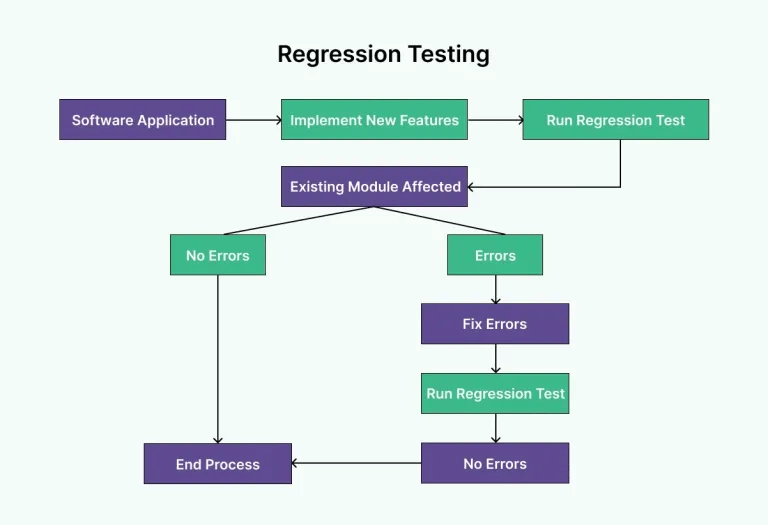
It can be done manually or through automation, and is most powerful when integrated into a CI/CD pipeline so tests run automatically on every code change. Popular tools include Selenium, Jest, Cypress, and Playwright.
When is Regression Testing Used?
Regression Testing is used whenever changes are made to the existing application to ensure that those changes do not affect previously working functionality.
Common scenarios where Regression Testing is performed:
- After Bug Fixes: When a defect is fixed, regression testing is done to ensure that the fix has not broken other parts of the application. For example, fixing a login issue should not affect registration or password reset features.
- After Adding New Features: Whenever new functionality is introduced, regression testing verifies that existing features continue to work correctly. For example, adding a payment option should not impact the checkout flow.
- After Code Changes: Even small code modifications or performance improvements can impact other modules, so regression testing is required.
- After System Updates or Configuration Changes: Changes in the environment, database, or dependencies may affect the system behavior.
- During Continuous Integration / Agile Development: In projects with frequent builds and deployments, regression testing is performed regularly to maintain stability.
Purpose of the Use of Regression Testing
The main reason we do regression testing is that simple software is never really finished. Code keeps changing. Every change can cause problems.
Here’s why it’s important,
- Code Changes Break Things: When developers modify existing code, they can accidentally break functionality that was working perfectly before. Regression testing finds these problems early.
- Software is Highly Interconnected: One module depends on another. A small change in the database layer can silently affect the UI. Regression testing verifies that the entire system still holds together after any change.
- Bugs Come Back: Fixed bugs have a habit of reappearing, especially when new code is added. Regression testing ensures old bugs stay fixed for good.
- Saves Time & Money: A bug caught during testing costs a fraction of what it costs to fix in production. Regression testing is an investment that pays back many times over.
- Builds Confidence to Ship: Without regression testing, teams are afraid to make changes. With it, developers can refactor, improve, and release new features with full confidence.
- Maintains Software Quality Over Time: As a product grows, its complexity grows too. Regression testing ensures quality doesn’t degrade as the codebase scales.
Advantages of Regression Testing
- Ensures Stability of Application → Regression testing verifies that existing features continue to work after changes, which helps maintain overall system stability.
- Detects Side Effects of Changes → When new features or bug fixes are added, they may unintentionally impact other modules. Regression testing helps identify these side effects early.
- Improves Software Quality → By continuously validating existing functionality, it ensures the product remains reliable and performs as expected.
- Supports Frequent Updates (Agile/CI-CD) → In modern development environments where changes happen frequently, regression testing ensures safe and smooth releases.
- Reduces Risk of Production Issues → Catching defects early during testing avoids costly fixes and failures in the live environment.
Disadvantages of Regression Testing
- Time-consuming → Re-running a large number of test cases after every change can take a lot of time, especially in big applications.
- Costly if Done Manually → Manual regression testing requires significant effort and resources, increasing overall testing cost.
- Requires Test Maintenance → Test cases need to be updated regularly as the application evolves, which adds extra work.
- Not Fully Efficient Without Automation → Without automation tools, regression testing becomes slow and less effective for large-scale projects.
- Can Become Repetitive → Executing the same test cases repeatedly may lead to tester fatigue and reduced efficiency.
Check out the best free nextjs template: Materio.

This is one of the best free vercel theme you can consider for your vercel projects.
How to Perform Regression Testing?

Step 1: Analyze Changes
The process begins by reviewing all modified code and new features to understand the full scope of what changed.
This includes:
- What code was added, modified, or deleted
- Which bug fixes were applied
- What new features were introduced
- How big or small the change is
Step 2: Identify Impacted Areas
Once changes are analyzed, the next step is to determine which modules, functions, and components are affected by those changes.
This includes:
- Mapping dependencies between modules
- Finding all areas that interact with the changed code
- Identifying both direct and indirect impacts
Step 3: Select Test Cases
Based on the impacted areas, testers choose relevant existing test cases from the test suite and create new ones if the change introduces functionality not yet covered.
This includes:
- Picking tests that cover the affected modules
- Writing new test cases for new features
- Removing outdated or irrelevant test cases
Step 4: Prioritize Tests
Not all tests are equally important. This step involves ranking the selected tests based on risk, business criticality, and how frequently that functionality is used by end users.
This includes:
- High-priority: payment, login, core user flows
- Medium-priority: secondary features
- Low-priority: rarely used or low-risk areas
Step 5: Execute Tests
Now the actual testing happens, run all selected test cases, both automated and manual, against the updated software.
This includes:
- Running automated test suites via tools like Selenium, Jest, and Cypress
- Performing manual checks where automation isn’t possible
- Recording results: pass, fail, or skip for every test
Step 6: Report Defects
Any failures or bugs discovered during execution are logged and documented clearly for the development team to fix.
This includes:
- Logging bug reports with steps to reproduce
- Attaching screenshots or logs as evidence
- Assigning severity and priority to each defect
Step 7: Retest & Validate
After developers fix the reported defects, testers re-run the failed tests to verify the fixes work and ensure no new regressions were introduced by the fixes themselves.
This includes:
- Re-executing previously failed test cases
- Running a quick sanity check on related areas
- Closing verified bugs and documenting results
Regression Testing Methods
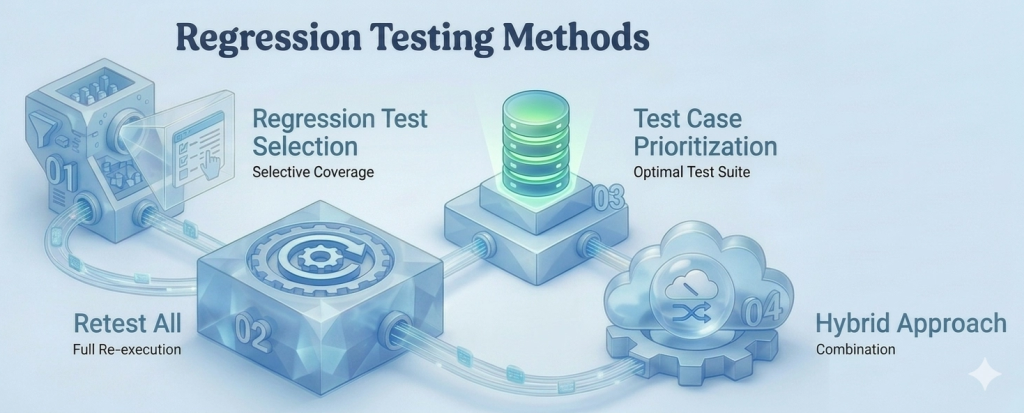
Regression testing is not performed in a single fixed way. Depending on the size of the application, time constraints, and project requirements, different methods can be used to execute regression testing effectively. Choosing the right method helps balance test coverage, time, and effort.
Retest All
- The “Retest All” method involves executing the entire test suite again after any change is made to the application. This approach ensures that every functionality, whether directly or indirectly affected, is validated.
Regression Test Selection:
- In this method, you choose the test cases that require retesting.
Test Case Prioritization:
- In this method, you collect all of the test scenarios and prioritize each.
Hybrid Approach:
- The Hybrid Approach combines both test selection and prioritization. First, relevant test cases are selected based on the impacted areas, and then they are prioritized according to their importance and risk. This is the most commonly used method in real-world projects because it provides a good balance between efficiency and coverage. It ensures that critical functionalities are tested without executing unnecessary test cases.
Types of Regression Testing
Regression testing can be categorized into different types based on how changes are applied and how testing is performed. Each type is used in specific scenarios to ensure software stability.
1. Corrective Regression Testing
Corrective Regression Testing is performed when no major changes are made to the existing code. Only minor bug fixes are applied, and the existing test cases are sufficient to validate the system. This type is simple and quick because it does not require creating new test cases. Testers just re-run the existing tests to ensure everything works correctly after the fix.
2. Retest all Regression Testing
In this type, the entire test suite is executed again, regardless of the size or impact of the change. It provides the highest level of confidence because every functionality is tested. However, it is time-consuming and resource-intensive, so it is usually used for small applications or critical releases.
3. Selective Regression Testing
Selective Regression Testing focuses only on specific test cases related to the changed or impacted areas. Instead of testing the whole application, testers carefully choose relevant test cases. This approach is more efficient and saves time, but it requires a good understanding of the system to avoid missing defects.
4. Progressive Regression Testing
Progressive Regression Testing is used when new functionality is added, or existing functionality is modified, and new test cases are required. In this type, both existing and new test cases are executed to ensure that:
- New features work correctly
- Existing features remain unaffected
5. Complete Regression Testing
Complete Regression Testing is performed when major changes are made to the application, such as:
- Large code updates
- Multiple module changes
- System-wide enhancements
In this approach, the entire system is tested thoroughly to ensure overall stability. It is similar to retest-all, but it is usually done after significant updates.
6. Partial Regression Testing
Partial Regression Testing checks that new changes work correctly along with a specific part of the existing system.
It focuses on:
- Changed modules
- Related modules only
This approach is faster than complete testing and is commonly used when changes are limited.
7. Unit Regression Testing
Unit Regression Testing is performed at the unit level, where individual components or modules are tested independently.
It ensures that:
- Changes in one unit do not break its functionality
- Dependencies are isolated during testing
This type is often performed by developers during early stages.
Regression Testing Tools
Regression testing is often supported by automation tools that help execute test cases efficiently, especially in large and frequently changing applications. These tools improve accuracy, reduce manual effort, and speed up the testing process.
Selenium
Selenium is one of the most popular open-source automation tools used for web application testing. It supports multiple programming languages like Java, Python, and JavaScript, and allows testers to automate browser actions. Selenium is widely used for regression testing because it can automate repetitive test cases and integrate with CI/CD pipelines.
Katalon Studio
Katalon Studio is an easy-to-use automation tool built on top of Selenium and Appium. It provides a user-friendly interface, making it suitable for beginners as well as experienced testers. It supports web, mobile, and API testing, making it a complete solution for regression testing.
Apache JMeter
Apache JMeter helps ensure that performance remains stable after changes and is widely used for load and stress testing, along with regression checks.
AdventNet QEngine (ManageEngine QEngine)
QEngine is a test automation tool used for functional and regression testing. It supports web application testing and helps automate repetitive tasks, improving testing efficiency.
Subject 7
Subject7 is a cloud-based automation platform that allows testers to perform regression testing without deep coding knowledge. It supports end-to-end testing and is useful for teams looking for scalable and collaborative testing solutions.
TimeShiftX
TimeShiftX is a specialized tool used for date and time-based testing. It is useful in regression testing scenarios where application behavior depends on time (e.g., billing cycles, subscriptions).
Cerberus Testing
Cerberus is an open-source test automation platform that supports web, mobile, and API testing. It provides a centralized interface for managing and executing regression test cases efficiently.
TestSigma
TestSigma is a modern, AI-driven test automation tool that enables testers to write test cases in plain English. It simplifies regression testing and supports web, mobile, and API automation with minimal coding effort.
Conclusion
Regression testing plays a critical role in ensuring the stability and reliability of software as it evolves. With continuous code changes, bug fixes, and feature enhancements, the risk of breaking existing functionality increases. Regression testing acts as a safety net by verifying that previously working features continue to function correctly after every update.
Throughout this blog, we explored the fundamentals of software testing, the importance of regression testing, when it should be used, its purpose, advantages, and disadvantages, different methods, types, and the tools that support it. Each aspect highlights how essential regression testing is in maintaining software quality and delivering a seamless user experience.
In modern development practices such as Agile and CI/CD, regression testing becomes even more important due to frequent releases. By combining the right strategies, methods, and automation tools, teams can perform regression testing efficiently and reduce the risk of defects in production.
In conclusion, regression testing is not just a testing activity but a continuous quality assurance process that builds confidence in every release and ensures that software remains stable, reliable, and ready for users.