


If half the people who land on your homepage leave without interacting, your bounce rate may have more to do with the theme than the writing, rewrite it twice, and watch the number stay where it was. The theme decides what happens in the first second. Only whoever survives that second reads the writing.
The Definition of a Bounce
A bounce is a session where the visitor arrives and leaves without a second interaction. Analytics platforms now count a session as engaged after ten seconds, a conversion, or a second page view. The bounce figure is now closer to a measure of immediate rejection.
That change matters for theme analysis. A visitor who reads for eleven seconds and leaves is no longer counted, which means the remaining bounces are dominated by people who decided against the page almost instantly. Those instant decisions are made on appearance.
Benchmarks by Industry
The average across industries is between 45% and 55%. Ecommerce sites average 20% to 45%, service businesses 15% to 50%, media and news 60% to 85%, and blogs 70% to 90%. The top quartile of all sites is at 36%.
Comparing your number to the wrong benchmark produces the wrong conclusion. A local plumber at 55% has a problem. A recipe blog at 55% is performing unusually well, because a visitor who reads the recipe and leaves got exactly what they came for.
Segment the figure before acting on it. Bounce on a homepage, a product page, and a contact page describe three different failures. Averaging them hides whichever one is costing money.
First Impressions and Visual Complexity
Research on aesthetic judgment found that people rate a page’s appearance within 50 milliseconds of seeing it, and later work pushed that down to 17 milliseconds. Two variables drove the ratings, which were visual complexity and how typical the layout looked for its category.
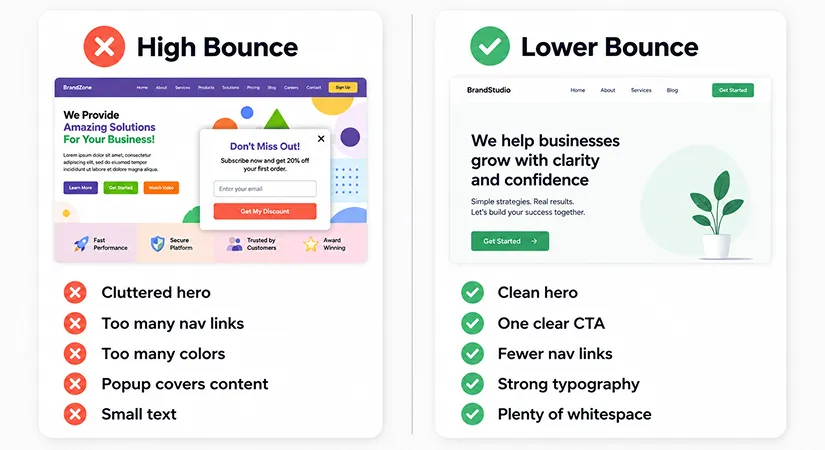
High complexity scored badly every time, across every category tested. This is the same mechanism psychologists describe when they study first impressions generally. The judgment forms before conscious evaluation begins, and everything the visitor reads afterwards is filtered through it. Developing quality websites therefore requires careful attention to visual hierarchy and simplicity, since these elements shape the visitor’s first impression before they engage with the content. A theme with four competing colours, an autoplaying video, and a cookie banner covering the headline loses that judgment before a single word is read.
Theme Weight and Server Response
Appearance is only half of the first second. The other half is arrival time, which depends on how much the theme loads and how quickly the server answers. A multipurpose theme shipping 40 features you never use downloads all of them anyway, and pages loading in over three seconds bounce 38% more than pages loading in under one. That’s why choosing cheap web hosting shouldn’t mean compromising on server performance, speed, or the resources your website actually needs.
Owners who trace the problem far enough usually end up changing two things together. A lighter theme reduces what has to be sent, and powerful web hosting reduces how long the visitor waits before anything starts.
Template Familiarity and Sameness
Prototypicality works in two directions. A layout that looks like other sites in its category performs well, because visitors know where to look without thinking. That is an argument for using a conventional template.
The same familiarity becomes a liability when the template is recognisable as a template. Tracking of the market share of content management systems shows a small number of platforms behind most of the public internet, and within those platforms a handful of themes appear on millions of sites.
A visitor who has seen your exact layout on three competitors reads it as a signal that nobody put any thought in. The usable compromise is a conventional structure with the header, the colours, and the photography changed. That keeps the familiarity and removes the giveaway.
Navigation Options and Decision Load
Themes ship with room for a lot of menu items, and owners fill the space. A header with eleven top-level links asks the visitor to evaluate eleven options before doing anything. A mega-menu that opens on hover raises that to 40.
The psychology here is established. The APA reported research showing that too many choices are mentally tiring and push people toward deferring decisions, which on a website often means leaving. A dependable Website backup is also essential to safeguard your website while you continue optimizing the user experience. Cutting a menu from eleven items to five is one of the few theme changes that reliably moves the number. The items removed rarely get missed, since most of them were there for the owner’s convenience and not the customer’s.
Mobile Themes and the Bounce Gap
Mobile sessions bounce at 51.8% against 39.7% on desktop, and that 12-point gap has not narrowed in three years. Pew’s data on smartphone ownership shows 90% of US adults with a smartphone and 37% using one as their main route online, so the mobile version is the version most visitors see. Designing on a laptop and checking on a phone at the end reverses the correct order of that work. Themes are still designed on large monitors. The tap targets that felt generous at 1440 pixels wide become 30-pixel links on a phone, the hero image that framed the headline pushes it below the fold, and the sticky header takes a fifth of the screen. Each of those is a theme setting rather than a content problem. Website design experts test tap size, hero height, and header height on a real phone before touching any content.
Typography, Spacing, and Reading Effort
Line length and text size measurably change how long somebody stays. Lines under 50 characters or over 120 characters both slow reading, and the useful range is 45 to 85. Line spacing of 1.5 is the accessibility minimum. Plenty of themes ship at 1.2 because it looks tighter in a demo.
Grey body text at 14 pixels looks refined in a portfolio screenshot and unreadable to a 55-year-old customer on a phone in a van. The fix takes four lines of CSS and no design skill. Set the base size at 18 pixels, raise the line height, and darken the body colour until the contrast checker stops complaining.
Back to the Opening Question
The question at the top has a three-part answer. The visitor left a page that took four seconds to arrive, offered eleven menu items before anything else, and set its body text two sizes smaller than the customer could comfortably read. Those are theme decisions and all three are reversible in an afternoon. The bounce rate is the only place they appear as a number.

