If you have experience with writing JavaScript, you might prefer using undefined instead of null. When considering null vs undefined in JavaScript, it’s important to note that these are two commonly misunderstood concepts. Though these values seem similar at first, they represent different ideas. Understanding the difference is important for any developer working with JavaScript.
In this blog post, we’ll explain what null and undefined are, how they vary, and when to use each in your code. Let’s dive in and clear up the confusion.
Table of contents
What is undefined in JavaScript?
undefined is an early value automatically assigned to a variable that has been declared but not assigned any value. It is also the default return value of functions that don’t return anything explicitly, undefined is a rudimentary value automatically assigned to variables in certain situations:
- Uninitialized Variables: A variable that is declared but not initialized will have the value undefined.
- Missing Function Return: If a function does not explicitly return a value, it returns undefined by default.
- Non-Existent Object Properties or Array Elements: Accessing an object property or an array element that does not exist results in undefined.
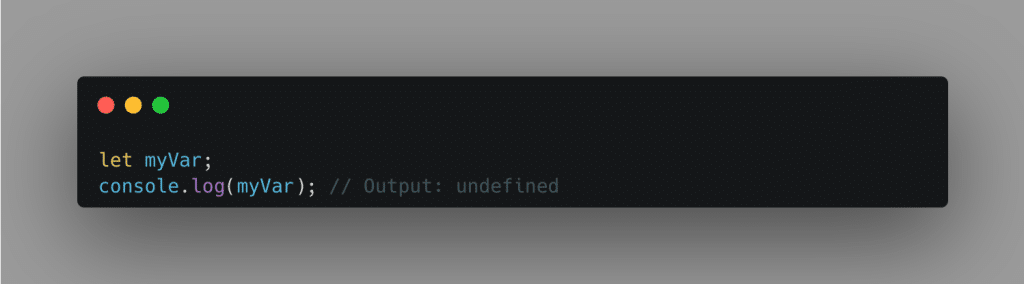
In the above example, the variable is declared, but it has not been assigned a value. When you try to access its value, it returns undefined. In JavaScript, undefined is also returned when you try to access a property or a method of an object that does not exist.
What is null in JavaScript?
null is a special rudimentary value that represents the intentional absence of any object value. It is an assignment value, meaning that it can be explicitly assigned to a variable as a representation of “no value” or “empty”. Also, it is a special value in JavaScript that represents the deliberate absence of any object value. It is often used to:
- Indicate “No Value”: null explicitly shows that a variable or object property should have no value.
- Reset or Clear Variables: Use null to reset a variable or remove its reference to an object.
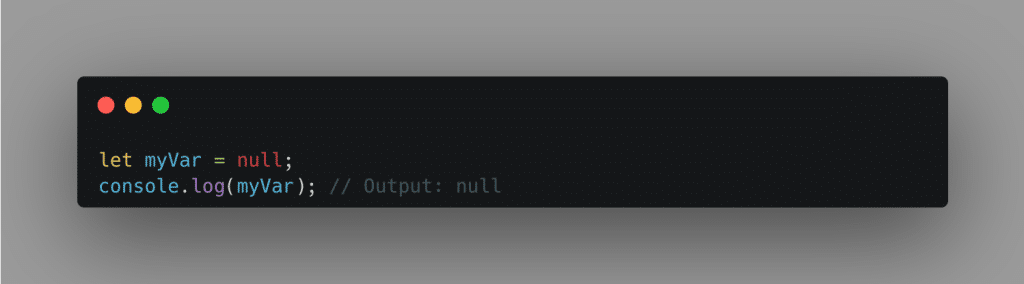
In the above example, the variable is assigned a value of null, which indicates that it intentionally does not have any value. Unlike undefined, null is explicitly assigned to a variable, property, or method.
null is often used to indicate the absence of an object, especially when initializing variables or clearing values in a data structure. Means there there is a valid variable with a value of data type number.
Following is the core difference of null vs undefined javascript.
Null vs Undefined Javascript: Core Difference
| Feature | null | undefined |
|---|---|---|
| Type | Object | Undefined |
| Default Value | No default value | Default value for uninitialized variables |
| Intent | Represents intentional absence of value | Represents absence of value due to lack of initialization |
| Assignment | Explicitly assigned | Implicitly assigned by JavaScript |
| Usage | Used by developers to reset or clear variables | Automatically assigned by JS when variables are declared without a value |
Equality Comparison (<strong>==</strong>) | null == undefined is true | undefined == null is true |
Strict Equality (<strong>===</strong>) | null === undefined is false | undefined === null is false |
Real-Life Examples to Demonstrate null and undefined
1. null as an Intentional Empty Value :
In to-do list application. You might want to reset a task’s status to null when it’s deleted:
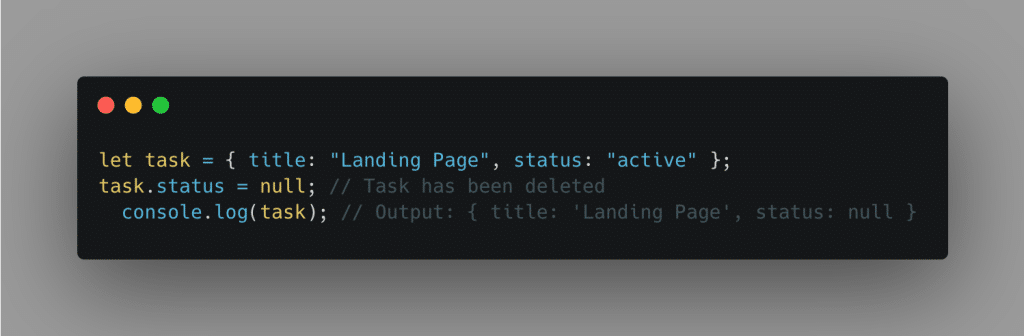
Here, we explicitly set the task’s status to null to signify the intentional deletion of the task.
2. undefined as the Default Value: When you declare a variable but don’t initialize it, JavaScript assigns it the value undefined.
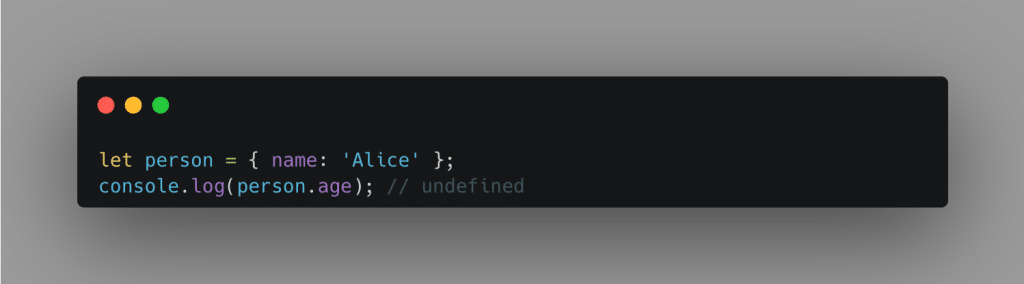
Here, the person name is defined but when we tries to print or get the person age as (person.age) it will give output as undefined.
Check out the best free bootstrap template:

Best Practices
- Use
===for comparison to avoid unexpected behavior when comparingnullandundefined. - Use default function parameters to avoid having to manually check for
undefined. - Leverage optional chaining to safely access properties on potentially
nullorundefinedobjects. - Be mindful when working with APIs that return
nullandundefined, as they may not be interchangeable.
Conclusion:
While both null and undefined signify “emptiness” in JavaScript, they have distinct purposes. null is used to intentionally indicate that a variable has no value, while undefined is automatically assigned by JavaScript when a variable is declared but not initialized.
Understanding these differences is vital for debugging and avoiding potential issues in your code. Keep in mind that using strict equality checks (===) is a safer approach to ensure you don’t run into unexpected behavior when comparing these values.